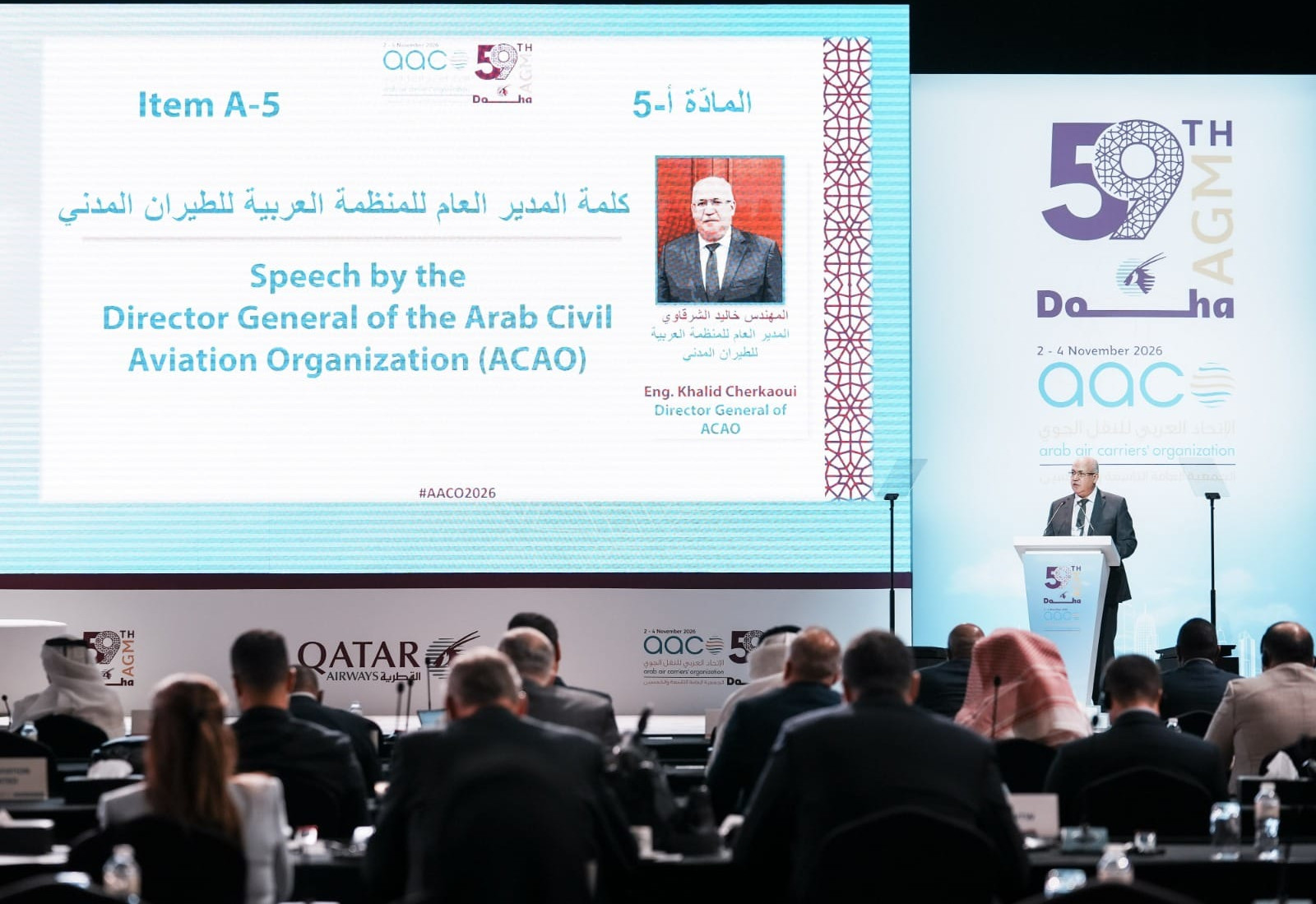
The Arab Civil Aviation Organization (ACAO), headed by H.E. Eng. Khalid Cherkaoui, Director General of the Organization, participated in the proceedings of the 59th General Assembly of the Arab Air Carriers’ Organization (AACO), hosted by Qatar Airways Group in Doha, State of Qatar, from 2 to 4 November 2026, under the patronage of H.E. Sheikh Mohammed bin Abdulrahman bin Jassim Al Thani, Prime Minister and Minister of Foreign Affairs of the State of Qatar. The event brought together more than 200 senior executives, aviation industry leaders, representatives of airlines, and regional and international organizations and institutions concerned with the air transport industry.
The General Assembly provided an important platform for exchanging views and discussing the key developments and challenges facing the air transport industry, amid ongoing geopolitical, economic and operational changes, and their implications for airlines and regional and international air connectivity.
In his opening remarks, Mr. Hamad Ali Al-Khater, Chief Executive Officer of Qatar Airways Group and Chairman of the 59th General Assembly, underscored the vital role played by Arab airlines in connecting people, businesses and economies across all six continents. He noted that ongoing geopolitical developments and the challenges they pose to operations and global air connectivity have made regional cooperation more important than ever.
He also emphasized the importance of building on and strengthening existing partnerships, enhancing the region’s capacity to address emerging challenges, and advancing a shared vision for the future of Arab aviation. He further expressed Qatar Airways’ pride in hosting this event and contributing to shaping a stronger future for the air transport industry.
For his part, Mr. Abdul Wahab Teffaha, Secretary General of the Arab Air Carriers’ Organization, presented an overview of the state of the air transport industry, highlighting key performance indicators and sector outlooks. He described 2026 as an exceptionally challenging year for the air transport sector and the region, while stressing that current challenges do not define the future of Arab air transport, which has consistently demonstrated its ability to overcome crises, recover and return to growth.
He noted that Arab airlines had achieved positive results in 2025, outperforming global averages, with passenger demand growing by 7.6%, compared with 5.3% globally. Air cargo demand among Arab airlines also increased by 4%, compared with 3.3% worldwide. The operating margin between revenues and operating costs for Arab airlines reached 11.8% during the same year.
However, he pointed to the challenging outlook for 2026, with passenger demand among Arab airlines expected to decline by 10.3%, and operating results projected to shift from a strong surplus in 2025 to a deficit estimated at 2.7%, amid the widening impact of the regional crisis and mounting operational and economic pressures.
He also addressed challenges relating to supply chains and aircraft delivery delays, noting that the average age of the Arab airline fleet had increased from 7.5 years in 2019 to 10.1 years in 2026. This has compelled airlines to continue operating older, less fuel-efficient aircraft. He concluded by reaffirming the aviation industry's commitment to achieving net-zero carbon emissions by 2050, while highlighting the importance of digital transformation, the development of digital passenger identity solutions, and the application of artificial intelligence in sales, distribution and passenger services.
As part of the General Assembly proceedings, H.E. Eng. Khalid Cherkaoui, Director General of the Arab Civil Aviation Organization, delivered an address in which he emphasized the importance of strengthening coordination and cooperation between ACAO, AACO, Arab civil aviation authorities and Arab airlines. Such cooperation, he stressed, is essential to building a more competitive, resilient, efficient and sustainable Arab civil aviation sector, capable of ensuring the continuity of air connectivity between countries and supporting economic growth and comprehensive development.
Addressing the current geopolitical and security developments in the region, and the resulting tensions and successive closures of certain airspaces, the Director General highlighted their direct impact on airline operations, including rising fuel prices and operating costs, as well as their implications for airlines’ financial performance. He stressed the importance of safeguarding civil aviation safety and security from conflicts and tensions, while ensuring the continuity of air transport operations and protecting connectivity between countries.
The Director General outlined three strategic priorities for the future of the Arab aviation industry: the transition towards more sustainable aviation; digital transformation and travel facilitation; and strengthening the economic and regulatory environment in which Arab airlines operate.
With regard to environmental sustainability, he highlighted the importance of monitoring international developments relating to the Carbon Offsetting and Reduction Scheme for International Aviation (CORSIA), Sustainable Aviation Fuel (SAF), and coordinating positions on environmental measures and regulations affecting airlines. In this regard, he referred to the unified Arab position adopted by the civil aviation authorities of ACAO Member States concerning the European Commission’s proposal to extend the scope of the European Union Emissions Trading System to international aviation. The position emphasizes the need to avoid double counting and double regulation, while upholding the principles of non-discrimination, fairness and the established international frameworks.
He also addressed the importance of digital transformation and automation in advancing the civil aviation system, improving the passenger experience, enhancing operational efficiency, and strengthening safety and security standards. Furthermore, he underscored the need for coordination on economic and taxation-related matters, particularly the avoidance of double taxation and cumulative tax burdens that could undermine the competitiveness of Arab airlines.
In the context of promoting Arab integration, the Director General stressed the importance of continuing joint efforts to support the implementation of the Damascus Convention on the Liberalization of Air Transport between Arab States, as well as the Convention on Exemptions from Taxes and Duties on Air Transport Equipment and Devices. These instruments represent important tools for establishing a more open and integrated Arab aviation environment and fostering greater air transport connectivity among Arab countries.
He further emphasized that current challenges call for enhanced coordination among Arab institutions, stronger integration between the governmental and operational sectors, and a more coordinated Arab presence in international forums. He reaffirmed ACAO’s readiness to continue working closely with AACO, activate existing cooperation mechanisms and technical committees, and translate recommendations and studies into practical initiatives that serve the interests of Arab countries.
ACAO’s participation in the 59th General Assembly reflects its continued commitment to strengthening institutional cooperation and partnership with AACO, harmonizing visions and positions on priority issues facing the aviation industry, and reinforcing integration between civil aviation authorities and Arab airlines. These efforts aim to support the competitiveness and sustainability of the sector, enhance its contribution to economic and social development, and strengthen air connectivity among Arab countries and peoples.